Most returns in this category have nothing to do with quality. They happen because nobody
checked the thread before ordering, or because a valve that only needed a vinegar soak got
thrown in the bin.
This site exists to fix both problems. No jargon, no upsell — just what the dish crew
needs to know before spending money.
Built for the standard 7/8”-20 UNEF connection used on US commercial pre-rinse units, including
replacement duties on widely used valve bodies.
What it is
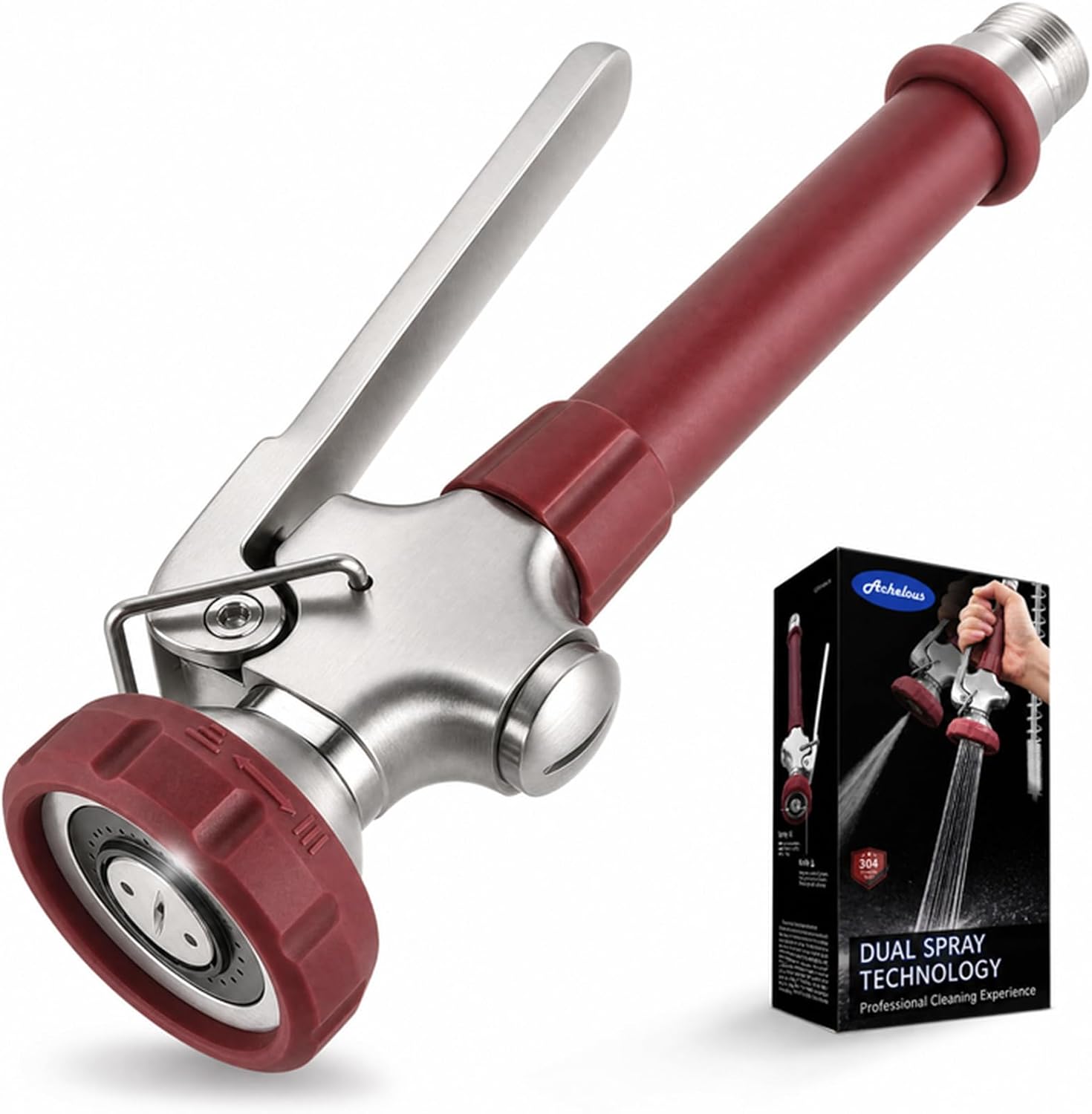
A direct replacement spray head for commercial pre-rinse assemblies — it threads onto
the hose end, not into the faucet body.
Model CFPJ-01-R (red handle). The same head ships as CFPJ01 (black) and
CFPJ-01-H (grey) — see the full lineup.
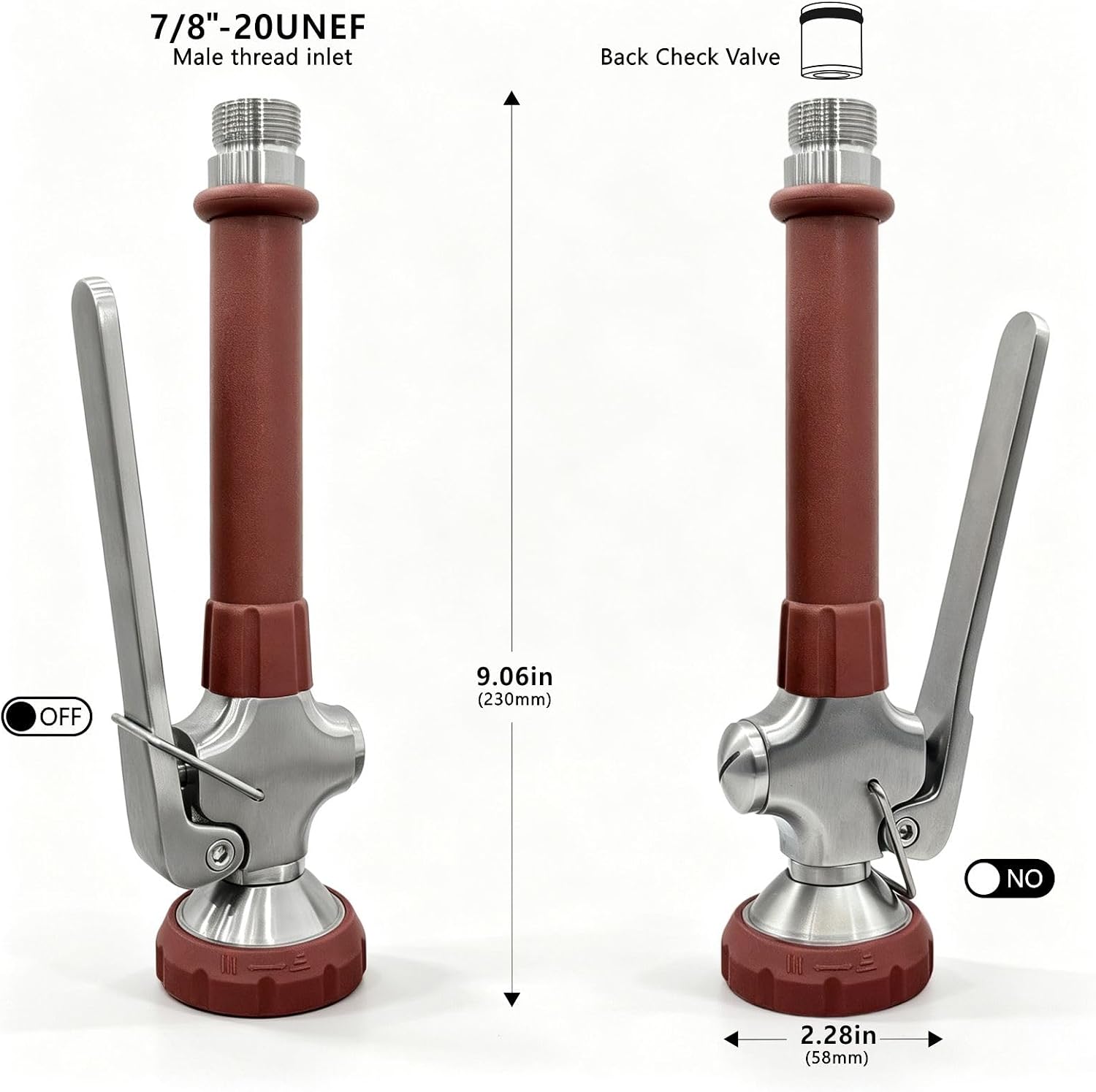
7/8”-20 UNEF connection. This is the standard on US restaurant pre-rinse hoses.
304 stainless steel metal parts, as marked on the product packaging.
Back check valve built into the inlet, per the factory spec diagram.
9.06 in (230 mm) overall length, 2.28 in (58 mm) across the face, as labeled.
Lifetime warranty per the warranty card supplied in the box.
Spare filters and O-rings included, so a lost washer does not turn into a
second order.
No adapter to a home faucet exists. We say this loudly because nobody else does, and
it's the number one reason this category gets returned. (Our 38” and 45”
assemblies do include three adapters — for a garden
hose and commercial spouts. Still nothing for a home faucet.)
Also available: the Brass Chrome model. Same Achelous Jet & Mist spray head,
built in brass chrome, and with an extra connection option: an optional
3/4”-14 end thread for installs that run without the handle. Same
lifetime warranty. If your hose end is 3/4”-14 rather than 7/8”-20 UNEF,
this is the model to check first →
Buying for a whole kitchen, or replacing everything at once? Achelous also makes
38” and 45” head-plus-hose assemblies (with three adapters included) and
replacement stainless hoses with 7/8”-20 UNEF on both ends. Every model, price
and stock status is on one page:
see the full lineup →
Still confirm the rest on the listing. The material, dimensions, warranty card and
spare parts above come from the product's own packaging, but flow rate and temperature
rating are not stated on either — verify those on the product page before you buy.
Quick reference
The connections you will actually meet
Thread
Where you find it
Fits this head?
7/8”-20 UNEF
End of a commercial pre-rinse hose. The industry standard in US kitchens.
Yes — direct thread-on
3/4”-14 UNS
The inlet into the spray valve body itself on many major-brand assemblies.
No — different position and size
1/2” NPT
Household faucets and many residential side sprayers.
Any pre-rinse assembly that terminates in a 7/8”-20 UNEF hose end accepts this style of head.
Whether it replaces that specific part in your setup depends on your hose end, not on the model
number on your old valve. Take thirty seconds to
measure yours — that's the only answer worth trusting.
Can I use this on a home kitchen faucet?
No. This is the single most common mistake in the category. Home faucets use 1/2” NPT or G 1/2”,
this head is 7/8”-20 UNEF, and there is no commercially available adapter between them. People have
checked hardware stores and industrial suppliers like McMaster-Carr and come up empty. Please don't
buy this hoping to make it work at home.
My spray got weak. Do I need a new one?
Probably not. Try the vinegar soak first — it's free and takes
twenty minutes, and it fixes the large majority of "the valve is dying" cases. Replace only if the
pattern stays ragged after descaling.
Should I rebuild my old valve instead?
Work through the decision guide. Short version: if you have
already rebuilt the same unit once in the last year, your labor has already passed the cost of a
replacement.
Do I need a plumber?
No. The head threads onto the hose by hand and gets snugged with a wrench. If the old one is seized,
a strap wrench frees it in about a minute. Close the supply stop first.